
A unique blend of artistic elements from local art forms in a land rich with diverse traditions (some of which are extinct today) like Ramanattam, Krishnanattam, Kathakali, Narayaneeyam .
Chavittu Nadakam - The ancient Operatic Theatre
Madhavi Puranam
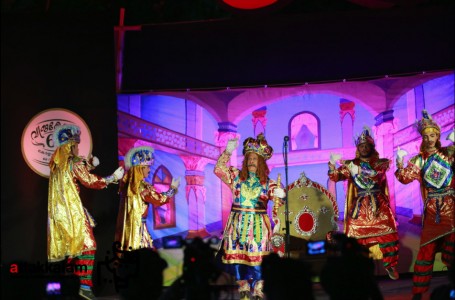
Chavittu-Natakam, the ancient tradition of operatic theatre, an almost forgotten and neglected performing art form of Kerala, which is replete with elements of western operatic traditions, dramatic local theatre and singing, Christian thematic content, and a performance technique amalgamated from various Kerala art forms which flourished at various periods from the 16 century in the Portuguese occupied coast of Kerala.
A unique blend of artistic elements from local art forms in a land rich with diverse traditions (some of which are extinct today) like Ramanattam, Krishnanattam, Kathakali, Narayaneeyam and Ashtapadiyattam, Thullal, and Kutiyattam, Chavittu-Natakam is, today, prevalent mainly in the Alppuzha, Ernakulam and Thrissur districts of Kerala. It is practiced mainly by the Christian communities who live by very humble circumstances. A carpenter, a mason, a daily wage labourer, or an auto-rickshaw driver during the day transforms into a teacher, choreographer, musician and artist during his free hours to keep alive a tradition which is woven into the very fabric of their lives. It strengthens family and community pride. Gothuruthu which was once ruled by a Christian royal family is an important centre of Chavittu-Natakam where the art has been preserved with pride and passion by old Christian families.
With the Portuguese arriving in 1498 (much before the Mughals conquered Delhi) Kerala has seen a wide assimilation of cultures over centuries through traders, travellers, religious missionaries and others. Other influences as varied as the Greek, Roman, Jewish, Dutch, French, English and even the Arab, Chinese and Syrians also affected Kerala's culture. The land saw a surge in the arts and literature between the 15th and 17th centuries. Chavittu-Natakam emerged in the 16th century in the coastal belt from Kotungalloore to Kollam when the Christian missionaries used the local art forms to evolve an operatic theatre with the flavour of local music, dance and theatre which rendered themes from the Bible and European history. This made an impression on the local populace which facilitated the propagation of the Christian faith. Performative elements from Kalaripayattu, Kutiyattam and other folk traditions were liberally used with nuances from later forms like Kathakali being added to it subsequently.
The word “chavittu” denotes steps and “natakam”, drama. The majestic stamping of feet in a soldierly march to the accompaniment of the percussion, chenda and cymbals, elattalam is a distinctive feature in the enactment of the story predominantly through song. With dramatic acting accompanied by full throated singing in ancient Tamil with very little verse, hand gestures and majestic and vigorous footwork accompanied by gymnastic feats, the predominant emotion is that of valour, especially in the elaborate realistic looking battle scenes in the plays. There is also an intervention of spontaneous humour/satire through a specialized character which is not seen any more in Chavittu-Natakam.
Some of the popular plays are that of Carleman Charitam (Charlemagne the Great and his peers redeeming Jerusalem from the Turks), Brijeena Charitham (Life of Queen Brijeena), Marthoma Sandesam (Message of St. Thomas), St. Sebastian, Daveedhum Goliyathum (David and Goliath), Mahanaya Alexander (Alexander the Great) and Veerayodhakkalude Anthyam (Death of Great warriors), Julius Caesar, Veerakumaran, Thyagaveeran (a story based during the times of Alexander), Jnana Sundari (fictional play with the backdrop of Rome and Jerusalem), and Angelica (story based on Emperor Charlemagne and his nephew Roldon). It is a sight to behold medieval European emperors, kings and knights in rich colourful silks, velvets and brocades with dazzling regalia and soldiers in crisp Greco-Roman uniforms; all with majestic crowns, helmets and armoury and bright regal make up.
Kolath George Asan, Varu Asan, Ambalathi Ouseph Asan, Poulose Asan are some of the legendary Chavittunatakam trainers and teachers whose disciples have continued the tradition but a detailed history of these teachers and their predecessors is missing. With little or no support from the state the groups are unable to sustain the training and performances; and with no scope of making the art into a career, they have to continue with their labour intensive job which leaves them with little time for the art. As older maestros are gone, the technique, lyrics, the singing as well as the histrionics of the dramas have seen a lot of dilution. The “chavittu” for which it is known, is far less majestic and the rubber boots in place of the old fashioned leather boots have reduced the aural majesty of the stamping. Cinema and the new phenomenon of introducing Chavittu-Natakam, since 2012, in the school youth festivals in the competition section has lead to youngsters taking to the form; but only at an elementary level which suffices to participate in the competitions asking for only a brief item or two. This does not call for elaborate training over a long period. The dramas are still performed in ancient Tamil in areas deep in the heart of Kerala. However, now the plays are being written in Malayam as well. Many of the drama texts and the manuscripts have also been lost. Traditional instruments like chenda, maddalam and elattalam have made way for instruments like tabla and keyboard, leading to the loss of the ethnic grain in the plays. Costumes too have lost their old world dignity, with cheap shine and shimmer dominating.
Chavittu-Natakam is an unique art form with a unique East -- West socio-cultural-religious history, ethos, and myriad literary and artistic influences, Chavittu-Natakam is a jewel in the rich tapestry of Kerala.
Madhavi Puranam is the Chief Editor of Nartanam, an Indian dance journal
